Collection, cost, production and sales on one data model, from specification to actual margin.
Stage: Preparing for a pilot
Monitor
Tablet
Phone
Built: the showroom, two-sided order confirmation, production and margin per article. I am finishing the end-to-end check, plus shipping and receiving. Next, a pilot with a first brand. The system is shown in a demonstration. Full scope of work: section 09.
Decisions are made before the data to support them exists
A fashion brand’s product and commerce have always lived in separate systems. The result is gaps in data, in timing and between the parties.
Data gap
The specification lives in a product development system (PLM), cost in a separate spreadsheet, the order on a wholesale platform and stock in the accounting system. Every figure has its own owner and its own date.
Feedback lag
Reconciliation is manual and happens after the period closes. The discrepancy surfaces when it is too late to act.
Asymmetry between parties
Brand and buyer hold different versions of the same order: confirmation, reservation and availability do not match.
The upshot: price, buying volume and assortment are decided on incomplete data.
02 — Design principle
I remove the cause of the gap, not its consequences
One data model
Industry systems cover either product or commerce and swap exports. Here a change to a specification flows through to cost and the permissible price, and both sides agree an order amendment in the same system.
The system does the calculating
The system calculates price, availability, reservation and confirmation, not a document sent by email. A document is out of date the moment it is sent.
Symmetry between parties
Brand and buyer work in one deal record and see one order. They do not exchange versions.
03 — Scope
Areas and steps from style to margin
The areas form a single chain. Each step takes the recorded result of the one before: nothing is re-keyed or moved by export.
Style and version
Specification and planned cost
Sample and tech pack
Production order
Publication to showroom and price list
Order and confirmation
Delivery
Actual cost
Margin and period close-out
Exhibit 2. System areas and the decisions they support
AreaManagement decisionImpact
Product and collection
Season planning, collections, styles and colourways, articles with barcodes, materials
and trims, measurement charts, samples, tech packs
What to make and how much, from the collection structure and last season’s results
The specification rebuilds when a style changes, so copies do not drift apart
Cost and economics
Specification and cost, price calculation, margin by style, category
and assortment
Target price and permissible cost, before the production order is placed
An unprofitable order is stopped before production starts
Sourcing and production
Suppliers, requests for quotation and purchase orders for materials, quotes, production orders,
production calendar, sample-based quality control
Whom to order from and when; what to run first when capacity is short
A missed deadline is visible in advance
Commerce and deal
Digital showroom, line sheets and assortments, buyer selections,
order, confirmation, order amendments, deal record
Confirmed commitments and free stock, at any moment
Price lists, reservations and confirmations are not sent as documents
Data and metrics
The shared data model under every area, metrics, management reporting
Where to put capital: categories, channels, seasons; where cash is tied up
The report is built from operational data, not by hand
Roles and partner access
Organisations, roles, permissions at object and operation level
Who is responsible for what when brand, retailer, distributor and manufacturer work together
A partner sees their own slice of the data, not a copy of a file
04 — Impact
What changes in day-to-day work
Exhibit 3. Today and in the system
ProcessTodayIn the system
Style specification
The file is rebuilt by hand,
copies drift apart
Recalculated on every change,
one version
Cost
A separate spreadsheet, recalculated after
every quote
Each quote is checked
against the permissible price
Availability to sell
Stock as at the last export
Calculated by the system, as at now
Reservation
A verbal agreement and an email
Atomic reservation: one unit cannot be sold twice
Order confirmation
Each side keeps its own version
One status for both sides
Management report
Compiled by hand, takes days
Generated from operational
data
05 — Parties
What each party in the chain gets
Brand, retailer and distributor work in the system. What it gives each of them is set out by role below; the investor has a separate section.
Brand
Sees the season’s economics while there is still time to change them.
Price and permissible cost are known before the production order.
One version of the data for factory, commercial team and buyer: specifications, measurement charts and tech packs stay aligned.
Buying and sales read the same figure: how much is already confirmed and how much is still free to sell.
Margin closes on actual cost, so the season’s result is a figure, not an estimate.
Retailer and retail chain
Orders what it will actually receive, and knows it immediately.
The retailer sees live assortment and availability, not a snapshot from the day a file was exported.
Confirmation is two-sided: brand and retailer share one order and one delivery date.
Its own account with its own slice of data, instead of a spreadsheet with columns cut out.
The retailer hears about a change to delivery date or contents in advance, before goods arrive.
What the retailer needs to do. The brand connects them: an invitation arrives by email and work happens in the browser, with nothing to install. No training is needed, because the order is built from the brand’s catalogue. The brand sets the terms of access.
Distributor
Runs both ends of the chain in one place, with different permissions.
Several brands and several retailers in one system, each with its own role
and its own access.
Individual prices and terms per partner, without copies of price lists
or manual substitution.
Commitments are traceable in both directions: what has been confirmed to the brand
and what has been promised to the retailer.
The system calculates reservations on both sides of the chain: see Exhibit 3.
06 — Scenario
How a season runs in the system
Phases of the season and roles, from product manager and buyer to production manager and the finance function.
Exhibit 4. Season phases, participants and the outcome of each
PhaseWho worksWhat happens
PreparationBefore production
starts
Product manager, buyer
Collection structure, styles
and colourways, materials and trims, specification and planned
cost. Output: the economics of each style, calculated before the first spend.
Samples and launchConfirming
feasibility
Product manager,
production manager
Measurement charts, samples,
tech packs, requests for quotation and quotes, placing production
orders. Output: confirmed lead times and cost.
Sales openingWorking
with the buyer
Brand sales lead, retailer
buyer
Publication to the showroom, price lists
and assortments, buyer selections, order and two-sided confirmation.
Output: the volume of commitments and free stock.
Delivery and close-outActuals
instead of plan
Production manager, finance
function
Shipping and receiving, actual
delivery cost, cost allocation, margin and period close-out.
Output: the season’s actual result instead of an estimate.
07 — Local context
The system is built for the Russian market, not adapted to it
The market is built into the core: Russian brands that work with Russian and overseas factories and suppliers of materials and finished goods.
Multi-currency calculation
Buying abroad and selling in roubles is the normal mode for a Russian brand. The rate is applied line by line at the required precision, because rounding at total level skews the result systematically. Bank of Russia rates are loaded into the reference, and the brand fixes the season’s rate with a date.
Import readiness
Registries of certificates (OEKO-TEX, GOTS) and conformity documents (UPD transfer documents, EAEU declarations and certificates) are kept alongside product data; documents are linked to the order and the shipment.
Industry reference
The categories, product types and size systems of Russian fashion retail are already in the reference, so the brand does not have to build it from scratch.
Integration with accounting
Which accounting systems to connect depends on the brand; the terms of integration are in section 10.
08 — Interface
The system at work
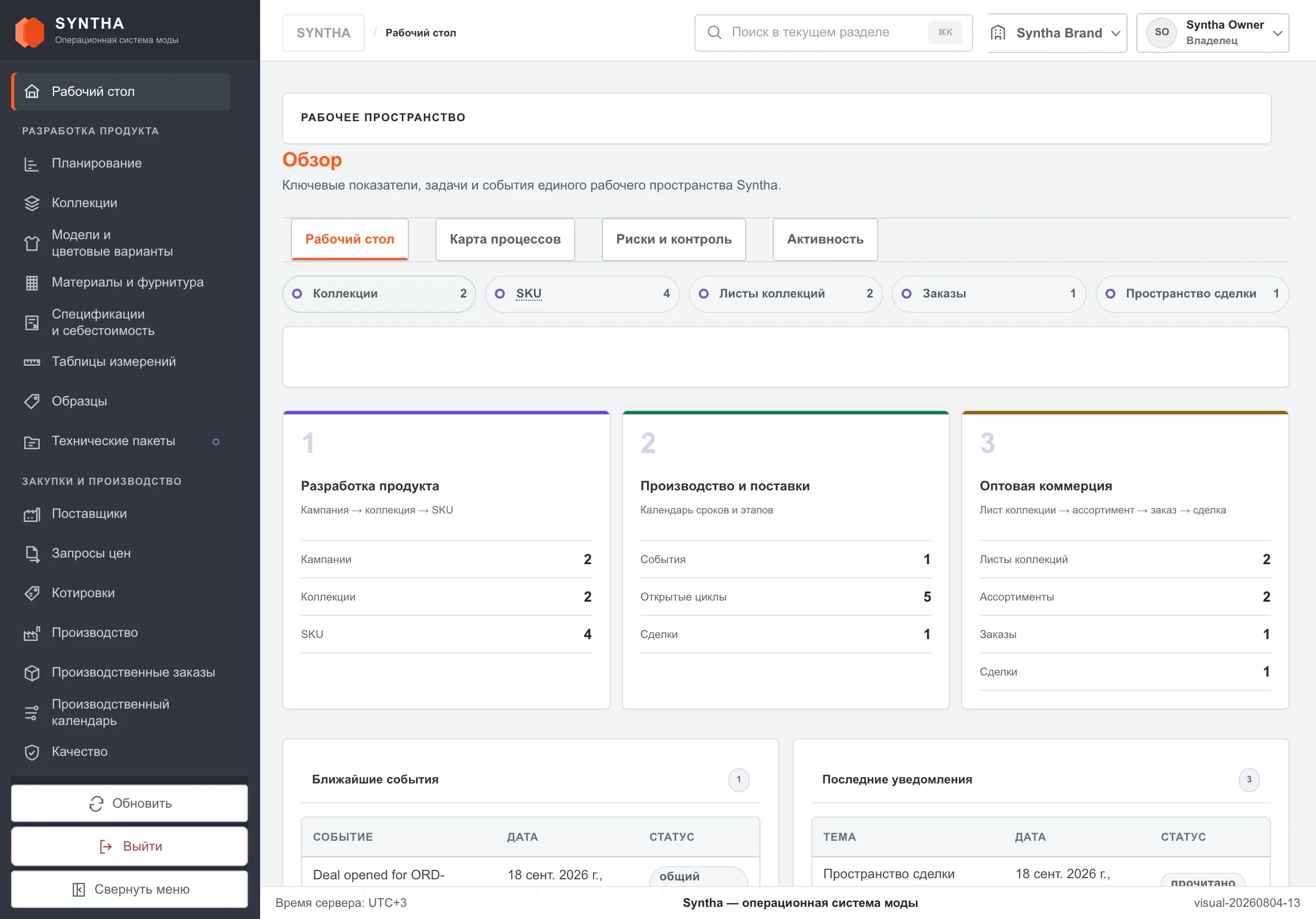
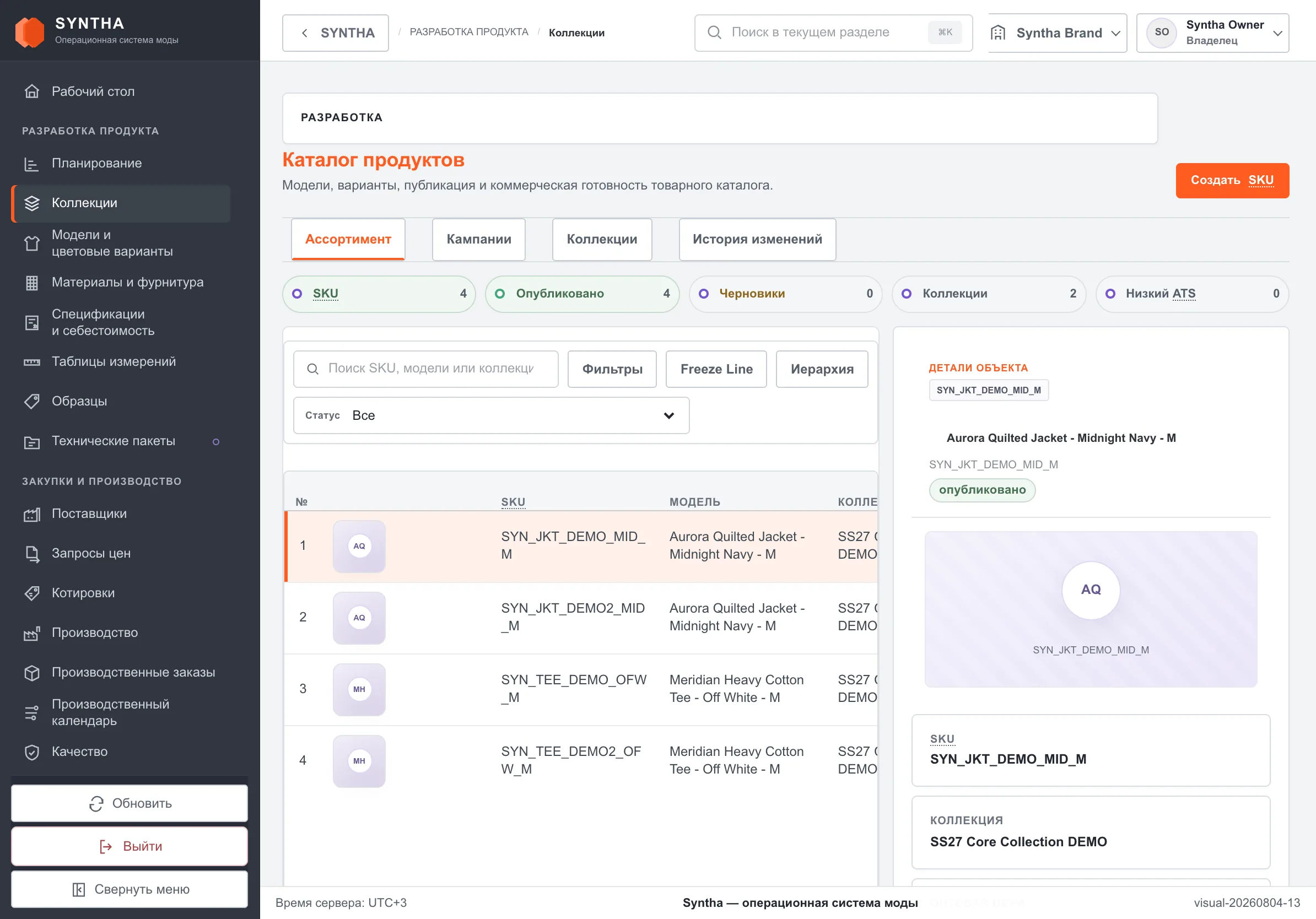
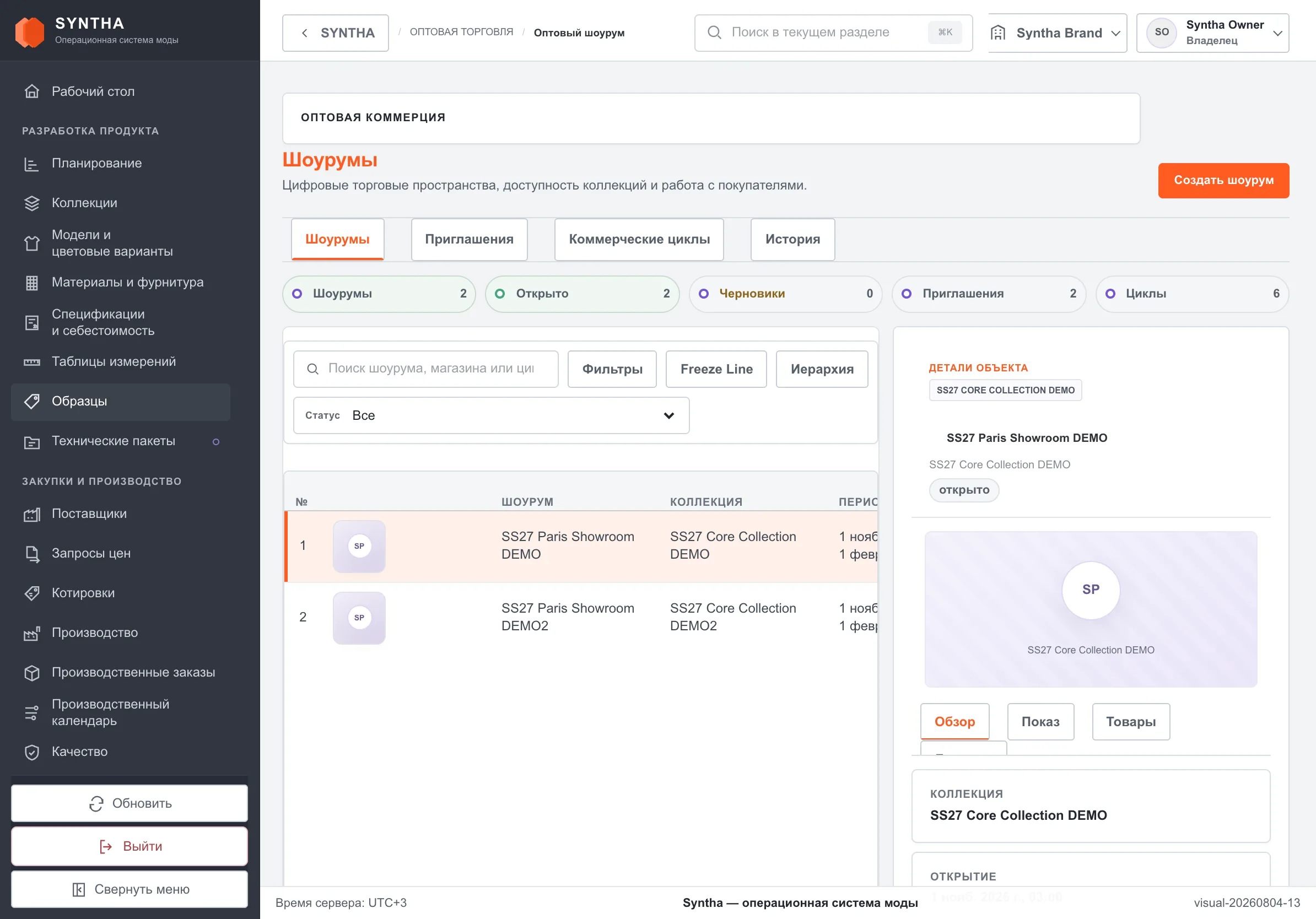
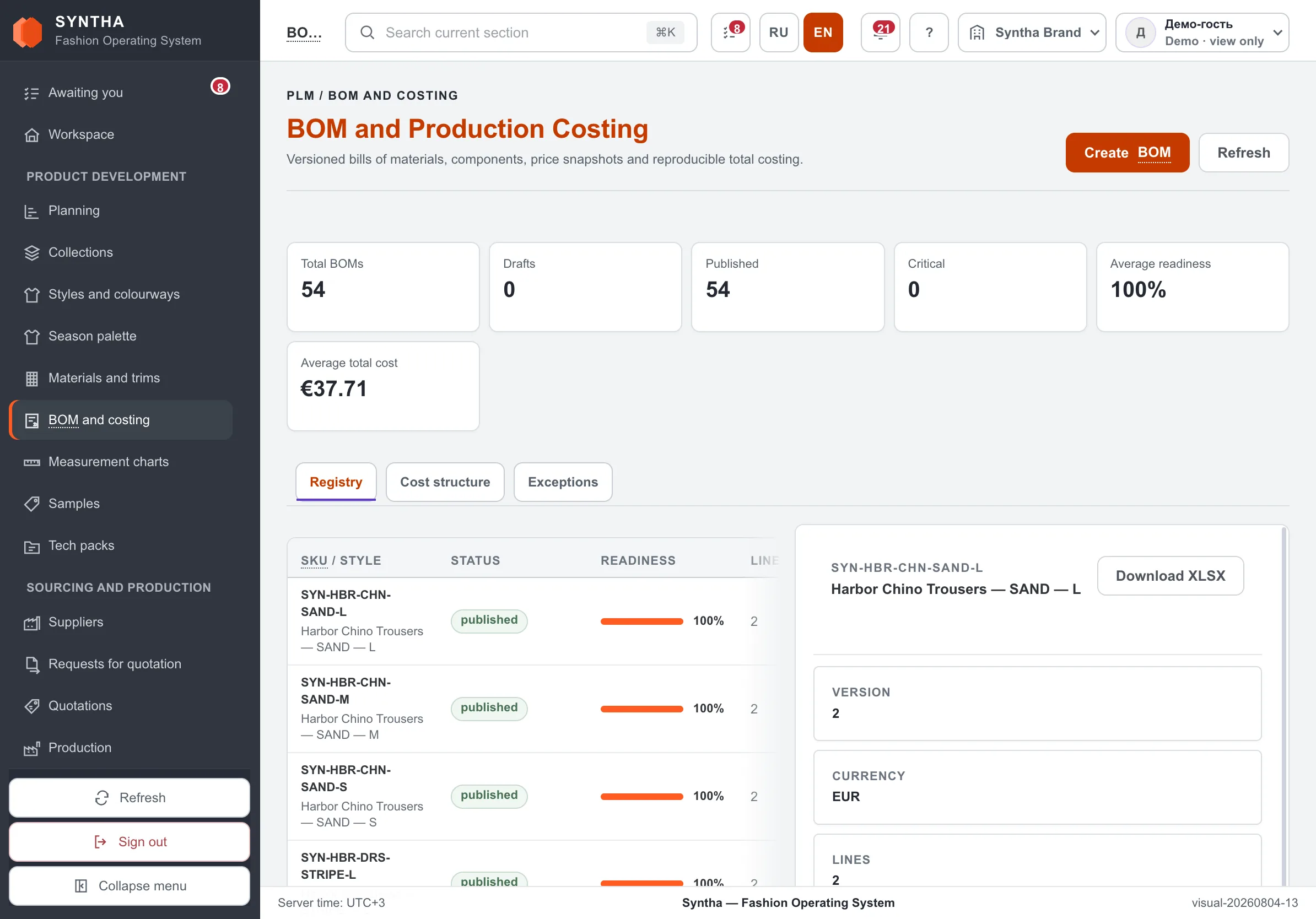
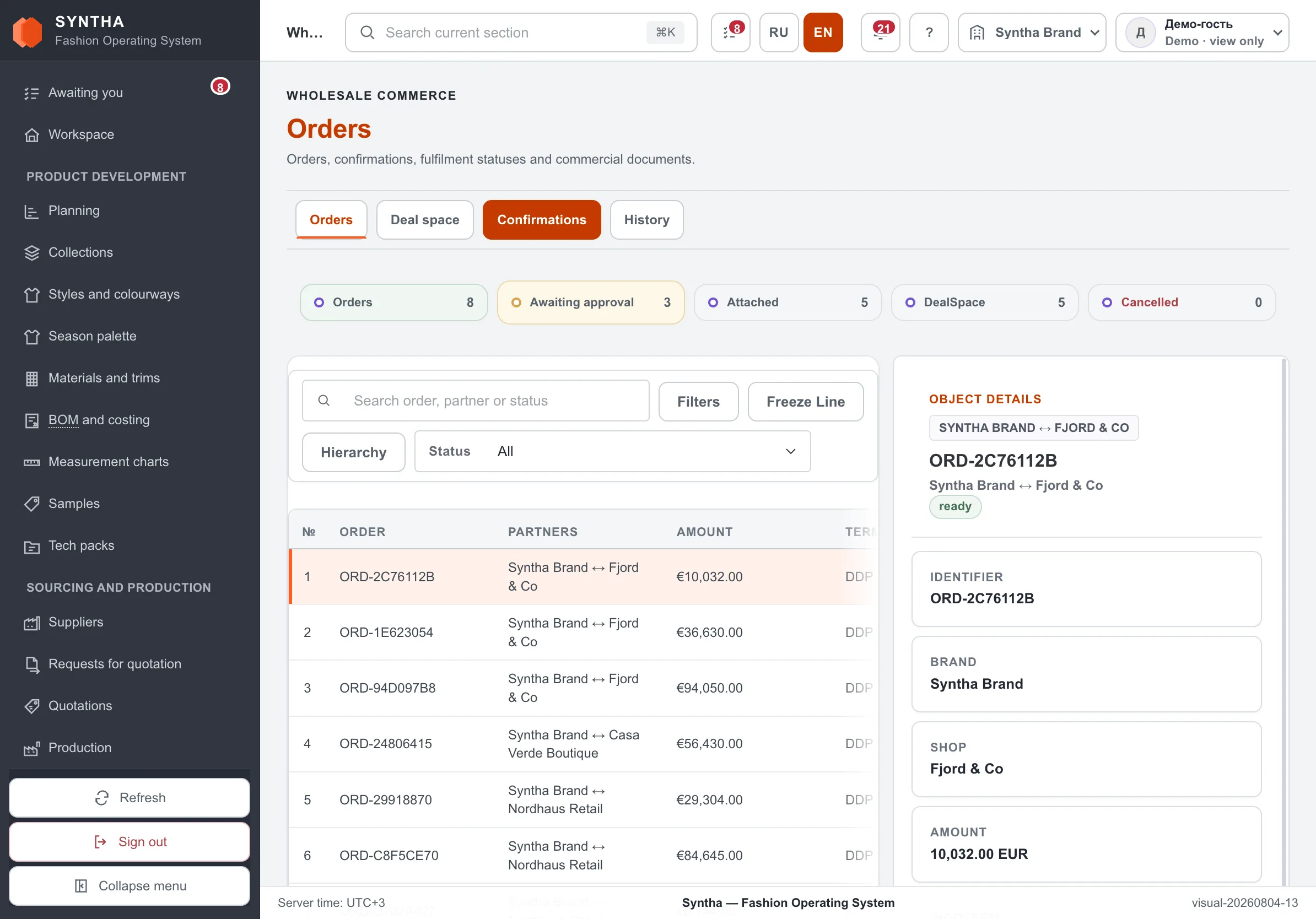
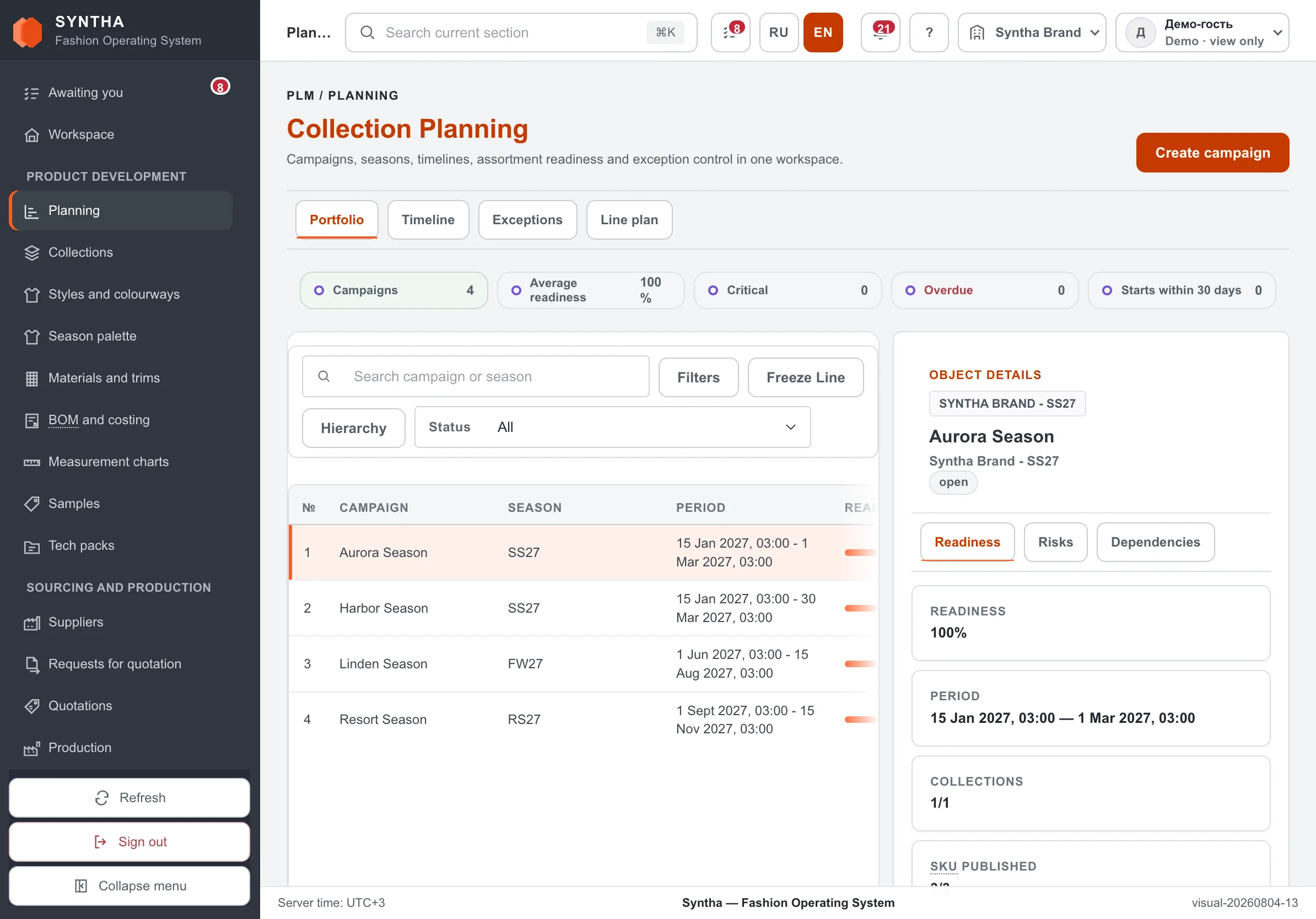
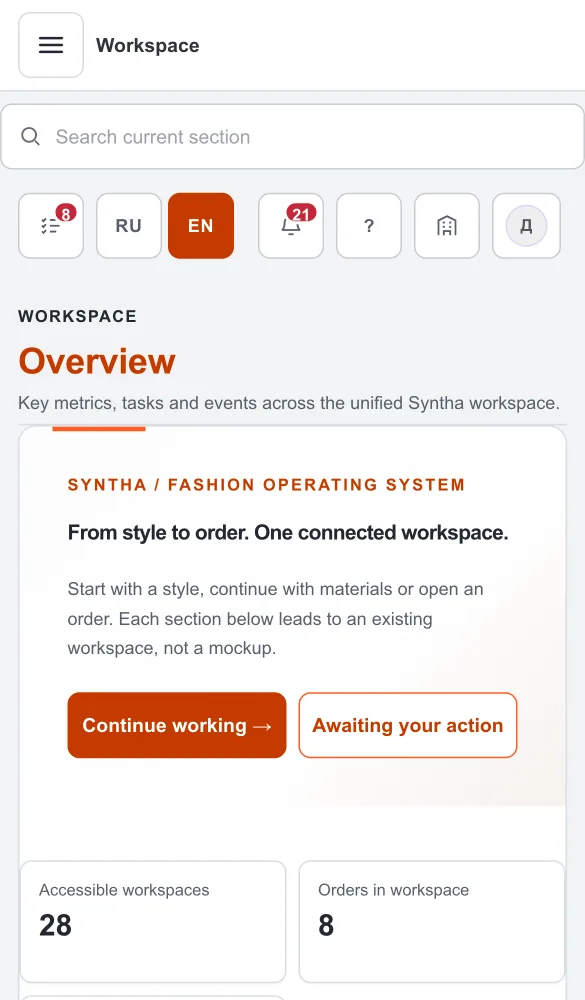
A working version, not mock-ups: the video walks through the sections, and the screenshots show the workspace, the product catalogue, the wholesale showroom, costing by bill of materials, wholesale orders, collection planning and the phone view.
09 — Stage
The commercial core and production module are built; I am preparing a pilot
Done
Organisations, roles and partner access, with a separate quality role; a register of legal entities
Digital showrooms; the server calculates catalogue prices; the buyer sees a fixed version of the catalogue; barcode and colour carry through to the order matrix
Stock reservation that prevents double-selling, controls on minimum order and availability, order confirmation by both sides, order amendments
Product: articles and barcodes, material specifications, measurement charts, samples, tech packs; registers of certificates and compliance documents
Production and sourcing: cutting, production orders, sample-based quality control, price requests and material orders
Order economics: cost per article, cost allocation, margin, period close; interface in Russian and English
Printed PDF forms (order, line sheet and lookbook, tech pack), XLSX export, signed notifications for integrations
Material-lot traceability; release of finished-goods quarantine by two separate roles
A guest showroom link without prices, hotspots on a look;
In progress
An end-to-end check of the product → order → margin chain
Price lists by market, validity period and tax
Shipping, receiving and claims: testing the full cycle
A single look for the interface: removing the last old styles
Next
A pilot with a first brand across a real season
Connecting to the brand’s accounting system
Looking for. I am looking for brands and retailers for a pilot, and a go-to-market partner.
10 — Involvement
Ways to get involved
Pilot
I provide a full season in the system, priority in the development queue, and migration and structuring of the brand’s data.
I expect one live season and a dedicated member of the brand’s staff for the whole cycle.
Go to market
A partner with a sales channel and rollout experience: sales and onboarding of brands go through them.
Investment
You can join before the first pilot; what is built is shown in section 09. I fix exact terms once the pilot has shown results.
Integration
Connection to the brand’s accounting system: a separate project with its own timeline and budget.
I show the architecture and the development plan in person.
Next: project details
Modules, scenarios, roles, what already works and what is next, a gallery and the way into the app.